v8にはunevalが無かったのでdankogaiさん作のuneval.jsを使わせて頂いた。
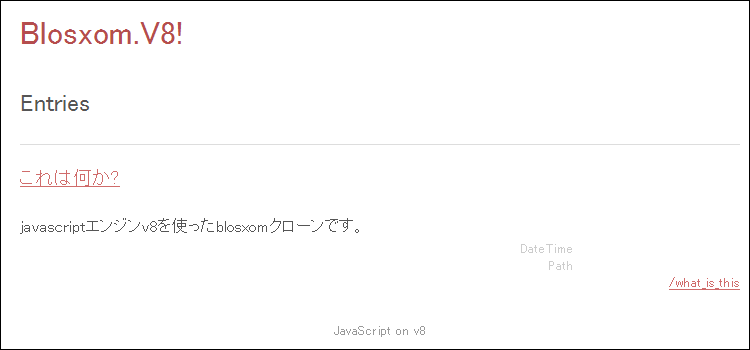
実行画面はblosxom.rhinoの書き換えなので、パクリ気味ですが...
fcgi-v8でファイル日付の取得が実装出来ていないので、今は日付は表示されていません。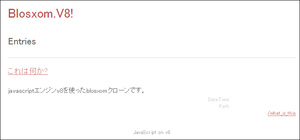
blosxom.v8よかったら遊んでみて下さい。
fcgi-v8でファイル日付の取得が実装出来ていないので、今は日付は表示されていません。
blosxom.v8よかったら遊んでみて下さい。
FILE* fp = fopen(...);

v8::Local<v8::Object> obj = v8::Object::New();

obj->Set(v8::String::New("value"), v8::External::New((void*)fp));
という様に、v8::Externalでメンバを追加してやれば良い。
v8::Handle<v8::Value> Print(const v8::Arguments& args) {

  bool first = true;

  for (int i = 0; i < args.Length(); i++) {

    v8::HandleScope handle_scope;

    if (first) {

      first = false;

    } else {

      printf(" ");

    }

    v8::String::AsciiValue str(args[i]);

    printf("%s", *str);

  }

  printf("\n");

  return v8::Undefined();

}
となってて、何でも文字列化してくれる様に思えてた。で実際
var obj = test();

print(obj.value); // ここでクラッシュ
こんな事やると落ちてしまうんだけど、良く考えたらExternalって言ってるんだから値の出しようもない。確かに以下の様なコードをshell.ccに含ませ
global->Set(v8::String::New("hoge"), v8::External::New(NULL));
javascriptから"print(hoge)"で例外を発生させた際のデバッグ出力で確かめたら
==== Stack trace ============================================


(No security context)

    1: DefaultString(this=00C104BD <JS Object>#0#,x=00E0068D <Proxy>#1#)

(No security context)

    2: ToString(this=00C104BD <JS Object>#0#,x=00E0068D <Proxy>#1#)

    6: arguments adaptor frame: 1->0

Security context: 00E006A1 <FixedArray[41]>#2#

    7: /* anonymous */(this=00C10361 <JS Global Object>#3#)


==== Details ================================================


(No security context)

[1]: DefaultString(this=00C104BD <JS Object>#0#,x=00E0068D <Proxy>#1#) {

  // stack-allocated locals

  var v = 01000135 <undefined>

  var s = 01000135 <undefined>

  // expression stack (top to bottom)

  [04] : 01000361 <String[8]: toString>

  [03] : 00E0068D <Proxy>#1#

  [02] : 00E0068D <Proxy>#1#

--------- s o u r c e   c o d e ---------

function DefaultString(x) {?  if ((typeof(x.toString) === 'function')) {?    var s = x.toString();?    if (%IsPrimitive(s)) return s;?  }?  if ((typeof(x.valueOf) === 'function')) {?    var v = x.valueOf();?    if (%IsPrimitive(v)) return v;?  }?  throw %MakeTypeError('cannot_convert_to_primitive', []);?}

-----------------------------------------

}


(No security context)

[2]: ToString(this=00C104BD <JS Object>#0#,x=00E0068D <Proxy>#1#) {

  // expression stack (top to bottom)

  [02] : 01002845 <String[13]: DefaultString>

  [01] : 00C104BD <JS Object>#0#

  [00] : 0100232D <String[8]: ToString>

--------- s o u r c e   c o d e ---------

function ToString(x) {?  if ((typeof(x) === 'string')) return x;?  if ((typeof(x) === 'number')) return %NumberToString(x);?  if ((typeof(x) === 'boolean')) return x ? 'true' : 'false';?  if ((typeof(x) === 'undefined')) return 'undefined';?  return ((x === null)) ? 'null' : %ToString(%DefaultString(x));?}

-----------------------------------------
とNULL参照している事が分かる。v8からすると"訳分かんない物をToStringして表示しようとしただけさ。"と言ったところか。
if (argv[0]->IsExternal()) {

    printf("[native code]");

    continue;

}
よくブラウザなんかで見かける"[native code]"という表示になる様にしました。
typedef enum _OBJECT_TYPE {

    OBJECT_TYPE_FILE_POINTER, // FILE*

    OBJECT_TYPE_WINDOW_HANDLE // ウィンドウハンドル

} OBJECT_TYPE;


typedef struct _OBJECT_VALUE {

    OBJECT_TYPE type;

    void* object;

} OBJECT_VALUE;


// 設定

OBJECT_VALUE* val = new OBJECT_VALUE;

val->type = OBJECT_TYPE_FILE_POINTER;

val->object = fopen("test.dat", "rb");

obj->Set(v8::String::New("value"), v8::External::New((void*)val));


// 取得

v8::Local<v8::Value> valueobj = obj->Get(v8::String::New("value"));

if (!valueobj->IsExternal()) return v8::ThrowException(v8::String::New("Exception: invalid object"));

OBJECT_VALUE* val = static_cast< OBJECT_VALUE* >(v8::Handle<v8::External>::Cast(valueobj)->Value());

if (val->type == OBJECT_TYPE_FILE_POINTER) {

    // FILE*な処理

} else

if (val->type == OBJECT_TYPE_WINDOW_HANDLE) {

    // ウィンドウハンドルな処理

}
こんな構造と設定および取得をすべき、という事になる。ここまで気付くのに結構時間を使ってしまった。
  v8::Local<v8::FunctionTemplate> t = v8::FunctionTemplate::New();

  v8::Local<v8::Template> p = t->PrototypeTemplate();

  p->Set("friendsTimeline", v8::FunctionTemplate::New(TwitterFriendsTimeline));

  p->Set("updateStatus", v8::FunctionTemplate::New(TwitterUpdateStatus));

  v8::Local<v8::ObjectTemplate> i = t->InstanceTemplate();

  i->Set(v8::String::New("username"), v8::String::New(""));

  i->Set(v8::String::New("password"), v8::String::New(""));


  global->Set(v8::String::New("Twitter"), t);
このTwitterFriendsTimelineには以下の様なコードを...
v8::Handle<v8::Value> TwitterFriendsTimeline(const v8::Arguments& args) {

  v8::Handle<v8::Value> ret = v8::Undefined();

  v8::Local<v8::Object> This = args.This();

  v8::HandleScope handle_scope;

  v8::TryCatch try_catch;


  v8::String::AsciiValue username(This->Get(v8::String::New("username")));

  v8::String::AsciiValue password(This->Get(v8::String::New("password")));


  CURL* curl = NULL;

  CURLcode res = CURLE_OK;

  char *auth;


  response_data = NULL;

  response_size = 0;

  curl = curl_easy_init();

  if (!curl) return v8::ThrowException(v8::String::New("Error: unknown"));


  int n = strlen(*username) + strlen(*password);

  auth = (char*) malloc(n + 2);

  memset(auth, 0, n + 2);

  strcpy(auth, *username);

  strcat(auth, ":");

  strcat(auth, *password);


  curl_easy_setopt(curl, CURLOPT_URL, "http://twitter.com/statuses/friends_timeline.json");

  curl_easy_setopt(curl, CURLOPT_USERPWD, auth);

  curl_easy_setopt(curl, CURLOPT_WRITEFUNCTION, handle_returned_data);

  curl_easy_setopt(curl, CURLOPT_FOLLOWLOCATION, 1);

  res = curl_easy_perform(curl);

  curl_easy_cleanup(curl);


  free(auth);


  if (res == CURLE_OK) {

    char* json = NULL;

    json = (char*) malloc(response_size+1);

    memset(json, 0, response_size+1);

    memcpy(json, (char*) response_data, response_size);

    v8::Handle<v8::String> source = v8::String::New(json);

    free(json);


    v8::Handle<v8::Script> script = v8::Script::Compile(source);

    if (script.IsEmpty()) {

        ret = v8::ThrowException(v8::String::New("Error: unknown"));

        goto leave;

    }

    v8::Handle<v8::Value> result = script->Run();

    if (script.IsEmpty()) {

        ret = v8::ThrowException(v8::String::New("Error: unknown"));

        goto leave;

    }

    if (!result->IsArray()) {

        ret = v8::ThrowException(v8::String::New("Error: unknown"));

        goto leave;

    }

    ret = result;

  }


leave:

  if (response_data) free(response_data);

  response_data = NULL;

  return ret;

}
さらにTwitterUpdateStatusには
v8::Handle<v8::Value> TwitterUpdateStatus(const v8::Arguments& args) {

  v8::Handle<v8::Value> ret = v8::Undefined();

  v8::Local<v8::Object> This = args.This();

  v8::HandleScope handle_scope;

  v8::TryCatch try_catch;


  if (args.Length() != 1) return v8::ThrowException(v8::String::New("Error: usage(message)"));


  v8::String::AsciiValue username(This->Get(v8::String::New("username")));

  v8::String::AsciiValue password(This->Get(v8::String::New("password")));


  v8::Handle<v8::Object> global = v8::Context::GetCurrent()->Global();

  v8::Local<v8::Function> func = v8::Function::Cast(*global->Get(v8::String::New("encodeURIComponent")));

  v8::Local<v8::Value> funcargs[1];

  funcargs[0] = args[0]->ToString();

  v8::Local<v8::Value> result_val = func->Call(global, 1, funcargs);

  v8::String::AsciiValue escaped(result_val->ToString());


  char* status = url_encode_alloc(*escaped);


  CURL* curl = NULL;

  CURLcode res = CURLE_OK;

  char *auth;

  char url[2048];


  response_data = NULL;

  response_size = 0;

  curl = curl_easy_init();

  if (!curl) return v8::ThrowException(v8::String::New("Error: unknown"));


  memset(url, 0, sizeof(url));

  strncpy(url, "http://twitter.com/statuses/update.xml", sizeof(url)-1);

  strncat(url, "?status=", sizeof(url)-1);;

  strncat(url, status, sizeof(url)-1);

  free(status);


  int n = strlen(*username) + strlen(*password);

  auth = (char*) malloc(n + 2);

  memset(auth, 0, n + 2);

  strcpy(auth, *username);

  strcat(auth, ":");

  strcat(auth, *password);


  curl_easy_setopt(curl, CURLOPT_URL, url);

  curl_easy_setopt(curl, CURLOPT_USERPWD, auth);

  curl_easy_setopt(curl, CURLOPT_WRITEFUNCTION, handle_returned_data);

  curl_easy_setopt(curl, CURLOPT_FOLLOWLOCATION, 1);

  curl_easy_setopt(curl, CURLOPT_POST, 1);

  curl_easy_setopt(curl, CURLOPT_POSTFIELDS, "");

  res = curl_easy_perform(curl);

  curl_easy_cleanup(curl);


  free(auth);


  if (res != CURLE_OK) {

    ret = v8::ThrowException(v8::String::New("Error: unknown"));

  }

  if (response_data) free(response_data);

  response_data = NULL;

  return ret;

}
これだけ準備出来れば、あとは
var twitter = new Twitter()

twitter.username = "my-username"

twitter.password = "my-password"

var statuses = twitter.friendsTimeline();

for (var n = 0; n < statuses.length; n++) {

    print(statuses[n].user.screen_name, ":", statuses[n].text);

}

twitter.updateStatus("v8エンジン12気筒");
こんなスクリプト書いて
# shell twitter.js
とかやればfollowerのステータスが出た後でメッセージがポストされます。このブログを応援する